When an ordinary “no” ends in big anger
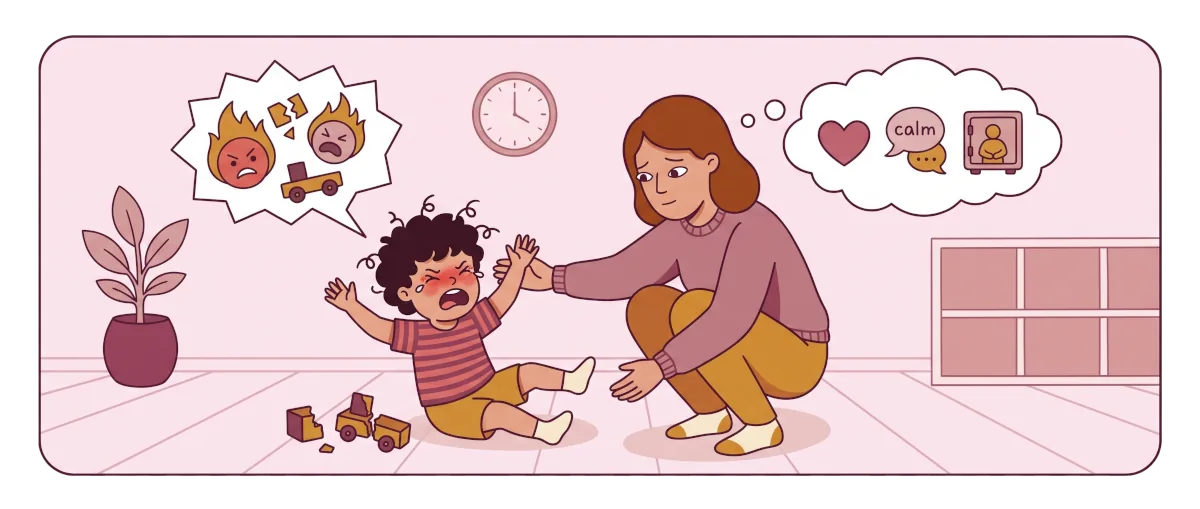
“We’re not buying that,” “it’s time to turn off the cartoon,” “we’re leaving the playground” — sometimes just one sentence is enough to bring on screaming, crying, or throwing themselves on the floor. It can be hard to stay calm in that moment, especially in a shop, on the street, or around other people. You may feel that any response will only add fuel to the fire.
A strong protest after being told no does not have to mean that your child is “naughty” or that you are doing something wrong. For a young child, the end of play, not getting another snack, or having a phone taken away can be a real disappointment. They are not yet able to easily say, “This is hard for me” or “I’m not ready to stop.”
In practice, the most important thing is to combine two things: calmly acknowledging emotions and clearly holding the boundary. You do not have to give in because of screaming, nor do you need to respond by shouting. You can say very little, keep everyone safe, and guide your child through the difficult moment step by step.
Why does being told no trigger such a strong reaction?
For an adult, “no” can be a simple response to a request. For a child, it may mean losing something they care deeply about right then. They wanted to stay on the swing, watch another episode, or decide for themselves what would happen next — and suddenly the plan changed.
Between roughly the ages of two and six, children are still practising how to cope with frustration. Emotions arise quickly, while controlling their reactions is much harder. So instead of a calm conversation, you may see stomping, crying, throwing a toy, kicking, or a loud “no!”
This does not mean that every behaviour should be accepted. Anger is allowed, but hitting, biting, and destroying things need to be stopped. It is helpful to separate the feeling from the action: your child has the right to feel disappointed, but they cannot hurt themselves or others in the process.
What can make protests worse?
Sometimes the problem is not the refusal itself, but the moment when it happens. After a long day, shopping, noise, or rushing, it may be much harder for your child to accept a change of plan. It is worth looking at the whole situation instead of judging only the last outburst.
Notice whether, before difficult moments, your child is:
- hungry or thirsty,
- sleep-deprived or unwell,
- tired from too much stimulation,
- caught off guard by play ending suddenly,
- being rushed,
- going too long without movement, rest, or calm connection with you.
You cannot prevent every difficult reaction through good planning. However, you can reduce situations in which your child is told no when they are already at the end of their tether. This often helps more than further explanations in the middle of a meltdown.
Before the tantrum: signals not to ignore
Many outbursts begin several minutes earlier. Your child may become whiny, repeat the same request more and more loudly, or suddenly stop cooperating with simple tasks. Sometimes, instead of noise, there may be withdrawal, a stiff body, or silence.
Parents often ask how to tell the difference between ordinary dissatisfaction and the moment when tension is already building. It helps to watch for repeated signs. The goal is not to predict everything perfectly, but to notice when your child needs fewer words, more clarity, and a calmer pace.
Signs of rising anger can include:
- increasingly insistent demands for one thing,
- a tearful or raised voice,
- clenched hands, a stiff body, or stomping,
- pushing away help,
- difficulty moving on to the next task,
- saying “no” to every request.
When you see these signs, try to slow down. Briefly say what will happen next, and do not add lots of questions at once. You might say: “I can see you don’t want to finish. You can go down the slide one more time, then we’ll put on your shoes.”
If the boundary has already been set, you do not need to explain it again with every protest. Sometimes a calm repetition is enough: “I understand that you’re angry. We’re not buying that toy today.” Your child does not have to be happy with the decision in order to hear it.
How can you say “no” without adding more tension?
During intense emotions, long explanations usually do not get through to a child. The more upset they are, the less helpful a list of arguments, a lecture, or the question, “Why are you behaving like this?” will be. A simple message and calm action work better.
You can use this short framework:
- Name the emotion: “You’re very angry.”
- Set the boundary: “I won’t let you throw the blocks.”
- Do what you say you will do: “I’m putting the blocks away for a while.”
This approach is not meant to make your child stop crying immediately. Its purpose is to show that their emotions have been noticed and that the rules still apply. This gives your child a clear signal about what happens in a difficult moment.
Talk about the behaviour, not the child
Words such as “angry child”, “naughty”, or “awful” can stay with a child longer than the situation itself. Rather than judging them as a person, describe specifically what you are stopping. This makes the boundary clear and prevents it from sounding like rejection.
Instead of saying:
- “You’re naughty,”
- “Stop behaving like that,”
- “What an angry child you are,”
you can say:
- “I won’t let you hit.”
- “I’m moving you away from your brother because kicking hurts.”
- “We don’t throw toy cars at people.”
- “You can be angry, but you can’t destroy this.”
Use simple sentences
In practice, one calm sentence is better than five instructions in a row. If the cartoon has ended, say: “The screen is off. Now it’s bath time.” You do not need to ask for permission if the decision has already been made.
It is also worth showing your child what they can do instead of the behaviour you are stopping. This is not a reward for screaming, but guidance for that moment. You might say: “We don’t throw stones. You can throw a ball into the basket,” or “We don’t hit. You can squeeze this pillow tightly.”
How to say “no” and what to say afterwards
A brief boundary does not have to end the conversation. Afterwards, you can name the next step or offer a choice, but only when both options are genuinely available.
Refusing a purchase
“We’re not buying that toy today.” If you plan to buy a snack and your child can choose it, add: “You can choose a banana or an apple.”
Ending playtime
“Playtime is over. We’re leaving.” If both options are possible, say: “Would you rather put your shoes on yourself, or would you like me to help you?”
Stopping unsafe behaviour
“I won’t let you throw stones. You can put the stone on the ground or hand it to me.” If your child does not put the object down safely, the adult takes it and the choice ends.
What should you do when your child screams, hits, or throws things?
When emotions are already very intense, the goal is not to win the conversation. Safety comes first — for your child, siblings, and anyone nearby. Only then can you return to what caused the anger.
1. Make the surroundings safe
Move away heavy, sharp, or breakable objects. If your child is throwing something in a shop, at the playground, or at home, move to a quieter place if possible. When the conflict involves siblings, separate the children and position yourself so they cannot hit each other.
You do not need to give a long speech. Calm action and a few words are enough: “I’m taking this object away so that no one gets hurt.” The less additional tension you bring into the situation, the easier it will be to gradually calm it down.
2. Stop behaviour that could hurt someone
If your child hits, bites, kicks, or throws an object at someone, respond straight away. You can gently stop their hand, move them away from the other person, or block access to objects that could cause harm. Do only what is necessary to keep everyone safe.
Helpful phrases include:
- “I won’t let you hit me.”
- “I’m stopping your hand.”
- “I’m moving you away from your sister because I won’t allow kicking.”
- “I can see that you’re angry. I’m keeping everyone safe now.”
Try to avoid pulling, shaming, and threats said in anger. Your child may need a firm response, but they do not need additional fear.
3. Do not change the boundary just to stop the protest
If the refusal concerns an important rule, safety, or an established daily routine, hold the boundary. If the screen has been turned off, do not turn it back on simply because the screaming gets louder. This does not mean being cold — you can stay close while keeping your decision.
Repeat the message without getting drawn into an argument: “The cartoon is over”, “We’re not buying sweets today”, “We’re leaving now.” You do not need to respond to every new “but”, “please”, or “just a little longer”.
4. Stay available, but do not negotiate in the middle of the storm
One child may want a cuddle, while another may pull away and need space. You can stay nearby while keeping a calm tone. A helpful sentence for this moment is: “I’m right here. When you’re ready, I’ll help you.”
Do not force a conversation, an apology, or a hug while your child is still crying intensely. First, they need to regain at least some calm. A conversation makes more sense only once the tension has clearly eased.
5. Return to the situation after your child has calmed down
After a few minutes, or later that day, you can briefly name what happened. This is not about questioning your child, but about giving them simple words and other ways to act. For example, say: “You were angry because we left the playground. Next time, you can say, ‘I want to stay longer,’ come to me, or stomp your feet hard next to me.”
Do not expect your child to use a new skill immediately in the next conflict. They learn through many repetitions. Every situation that is calmly stopped is an opportunity to practise.
Choice helps, but it does not replace a boundary
Children cooperate more easily when they have at least a small amount of influence over what is happening. The choice does not have to be about the rule itself. It can be about how your child follows it.
Instead of asking, “Will you go to the car?”, when it is already time to leave, try saying: “We’re going to the car. Would you rather walk by yourself or would you like me to hold your hand?” The adult still makes the decision to leave, while the child can choose a detail.
Useful examples:
- “It’s time to tidy up. Will you start with the cars or the blocks?”
- “We’re not buying a lollipop. Would you like a banana or an apple?”
- “It’s time to brush your teeth. Would you like strawberry or mint toothpaste?”
- “We’re leaving the playground. Will you say goodbye to the swing or the slide first?”
Offer only options that are genuinely possible. A pretend choice quickly becomes frustrating when your child hears a question but has no real say in the answer. Clarity is easier for them than lengthy negotiations.
If, after thinking it over, you decide you can change your mind, say so clearly. You might say: “I’ve thought about it, and I’m saying yes today.” Do not present the change as a result of screaming, though, because then it is harder for your child to understand when talking can change something and when a boundary is firm.
How can you prepare your child for a difficult “no”?
Most protests happen during transitions: when playtime ends, when leaving the house, turning off a screen, tidying up, or beginning the bedtime routine. Children often need a moment to say goodbye to one activity and move on to the next. A sudden change is usually harder than one they have been warned about.
A simple warning combined with information about what comes next can help. Instead of saying “We’re leaving!” at the last second, you can say: “We’ll finish playing in a moment. Then we’ll go to the car and have a snack.” This does not guarantee a calm reaction, but it reduces the element of surprise.
You can adapt the message to your child’s age:
- Younger child: “One more time down the slide, then shoes.”
- Older preschooler: “Choose one last game, then we’re leaving.”
- For screen time: “We’re turning it off after this episode. Then you can choose blocks or drawing.”
- For tidying up: “In two minutes, we’ll put the toys away. I’ll help you get started.”
It is also worth reducing the number of prohibitions that can be avoided by organising the space. Items your child should not touch are best kept out of reach. A consistent order for evening routines, a snack before a longer outing, and time for movement can also reduce the number of difficult moments.
The goal is not for your child to never hear “no”. Boundaries are necessary. It helps, however, when they concern things that are truly important rather than appearing automatically in response to every request.
What usually makes the situation worse?
Every parent may raise their voice or explain for too long at times. Difficult moments can trigger strong emotions in adults too. Rather than treating this as a reason to blame yourself, it is worth seeing it as a clue about what you might simplify next time.
Long explanations in the middle of crying
When your child is intensely angry, they do not need a full explanation of the decision. Keep it brief: “I know you want to stay. We’re leaving now.” Return to the reasons later, when you are both calmer.
Threats you do not want to or cannot follow through on
Statements like “We’re never coming here again” may come out in the heat of the moment, but they are difficult to stick to later. It is better to say what you are doing now: “We’re finishing the shopping because throwing products is not safe.” A simple action is clearer than a big punishment.
Giving in without thinking it through
Sometimes you may change your mind, and that is okay. What matters is not doing it simply to stop the screaming immediately. Before you say “no”, pause for a second and check: is this boundary necessary, or can you find a safe alternative?
Punishing the emotion itself
Your child does not choose to feel disappointed. However, they do need to know what they can do with that emotion. Instead of, “You’re not allowed to be angry,” try: “You can cry and stomp your feet. You cannot throw stones.”
When is it worth discussing the situation with a paediatrician or psychologist?
Crying, screaming, and protesting after being told no can happen as part of everyday development. They are especially common when a child is tired, plans change, or something enjoyable comes to an end. The fact that your child sometimes becomes angry does not in itself mean there is a serious problem.
However, it is worth speaking with a paediatrician or child psychologist if the outbursts are very frequent, unusually intense, or if it is difficult to keep everyone safe. A consultation can help you make sense of the situation and look at what happens before and after these reactions.
Seek support especially if the following happen regularly:
- biting, hitting, kicking, or throwing heavy objects,
- destroying objects during anger,
- behaviour through which your child hurts themselves,
- risk to siblings, peers, or adults,
- clear difficulties at preschool, school, or in everyday relationships.
If your child is trying to seriously hurt themselves, poses a danger to someone, or you are unable to keep everyone safe, seek immediate medical or emergency help. Move dangerous objects away and do not leave your child alone if you can safely stay with them.
Before a consultation, you can make brief notes for a few days. Write down what happened before the outburst, approximately how long it lasted, what helped, and how your child slept, ate, and functioned that day. This information makes it easier to identify recurring situations without guessing.
Summary: a calm boundary can still be firm
A tantrum after hearing “no” is not proof that the boundary was a mistake. Your child may feel disappointment intensely while also needing a clear stop when their behaviour becomes unsafe. Warmth and consistency can go hand in hand.
In a difficult moment, remember four simple steps:
- keep everyone safe - move objects away, separate children, stop hitting;
- briefly say what is happening - “I won’t let you hit”;
- do not add lots of words - stick with one calm message;
- return to the conversation later - when your child has regained more calm.
You cannot stop every angry reaction straight away. But you can help your child know what to expect: their emotions are noticed, safety matters, and boundaries do not disappear just because things get loud.
If outbursts are frequent, very intense, or you would like calm support in planning your next steps, use the BehaviorComplainer consultation form.
Sources
- American Academy of Pediatrics (AAP), “What’s the Best Way to Discipline My Child?”.
- American Academy of Pediatrics (AAP), “Top Tips for Surviving Tantrums”.
- Centers for Disease Control and Prevention (CDC), “Tips for Creating Rules”.